


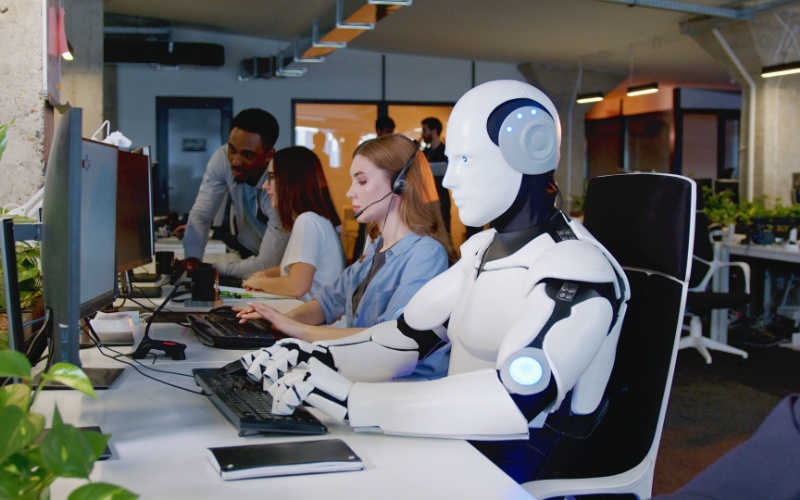
2023 was what we could call generative AI’s “wow!” moment. It opened the doors of plenty of new use cases for AI, and made the technology readily available to literally everyone. 2024 has been the year for understanding the power genAI could add to business and specific tasks, but also showed the limits of the technology.
This is particularly true in the marketing field where we have seen a rise in AI-driven marketing campaigns, whether marketers use AI to get deeper insights into data, or create more content, faster.
And Australia is leading the way with recent research showing that Australian businesses currently create half (49%) of their social media content using genAI, with the number expected to reach 61% by 2026. This is above the average rate of marketers in regions like North America, Europe and other Asia Pacific countries.
AI has also already started directly impacting marketers’ everyday jobs, with more professionals needing to train to become ‘prompt engineers’, learning how to interact with genAI in the best way. On the flip side, we’ve seen AI negatively impact organisations because some marketers didn’t realise the limitations or dangers of such powerful tools – poorly written content, biased decisions, inaccurately designed personalisation journeys, the list is long.
When looking at 2025, one might wonder how AI – particularly genAI – will continue transforming the marketing function. We expect that organisations in Australia will overall dive even deeper into using AI tools, with a clearer understanding of what works and what doesn’t.
My personal (hopeful) prediction, which is grounded in the realities of AI’s opportunities and risks, is that 2025 will be the year where we deepen our relationship with the technology, and when collaboration becomes truly at the centre of AI strategies.
Here are the evolutions and developments I predict we’ll likely see in the next 12 to 18 months:
● My robot colleague: agentic AI co-workers – These are AI systems that can act autonomously, pursuing specific goals while interacting with people and other systems to complete complex tasks. Unlike today’s AI tools, which mostly generate content or make suggestions, agentic AI will actively execute decisions, manage workflows and collaborate in real-time with human teams. This means marketers have the potential to build and work alongside ‘AI colleagues’ who can take action and provide insights.
● AI-Enhanced collaboration tools bringing teams closer together – We all know how it can be difficult for marketers, who are at the centre of a lot of broader business-wide strategies – to effectively collaborate across different teams and functions. 2025 will bring new AI-powered tools for virtual meetings, project management, and cross-functional document collaboration, which will be invaluable for marketers. Particularly, AI will assist in task prioritisation and team coordination, making hybrid and distributed teams more efficient.
● Search that learns: adaptive AI-powered search – Generative AI will change how we search for information within organisations, making it more adaptive, context-aware, and intelligent. This is particularly relevant for marketers – and anyone involved in building customer experience journeys. Unlike traditional keyword-based searches, adaptive AI-powered search will understand the user’s intent, interpret ambiguous queries, and deliver more personalised results – taking into account the user’s role, preferences, and behavior. Add to that RAG-based generative AI search, which continuously learns from user interactions, and marketers will be able to gather smarter, more informed, more accurate responses over time.
● Hyper-personalisation at scale – From products and services to marketing strategies, AI will use real-time data from various touchpoints – website activity, purchase history, social media engagement – to create individualised content and recommendations. This personalised approach will boost customer loyalty and retention by creating an unprecedented customer experience. This also means that marketers need to be on top of their game when it comes to how they collect, store and manage data, as ultimately AI’s outcomes are highly dependent on the quality of the data the tool is being fed.
Regardless of whether each one of those trends will eventuate exactly as I predict, one thing is certain: we’re moving out of the information age and into an age where humans and AI co-exist. It’s exciting, transformative, but most importantly it’s an opportunity to shape a future where AI augments human potential in ways we’re only beginning to understand.
● Smarter RegTech: ethical AI frameworks and compliance automation – Talking about data, one of the consequences of using more data-driven technologies is the scrutiny organisations are now under. Using data ethically, and meeting growing compliance requirements with more regulations is becoming more top of mind (and frankly non-negotiable) for marketers. The good news is that genAI will become a key player in enforcing ethical standards and maintaining compliance. For example, new tools will be able to automatically detect and mitigate biases, track AI usage across different departments, and even generate compliance reports for regulators.
Regardless of whether each one of those trends will eventuate exactly as I predict, one thing is certain: we’re moving out of the information age and into an age where humans and AI co-exist. It’s exciting, transformative, but most importantly it’s an opportunity to shape a future where AI augments human potential in ways we’re only beginning to understand.