


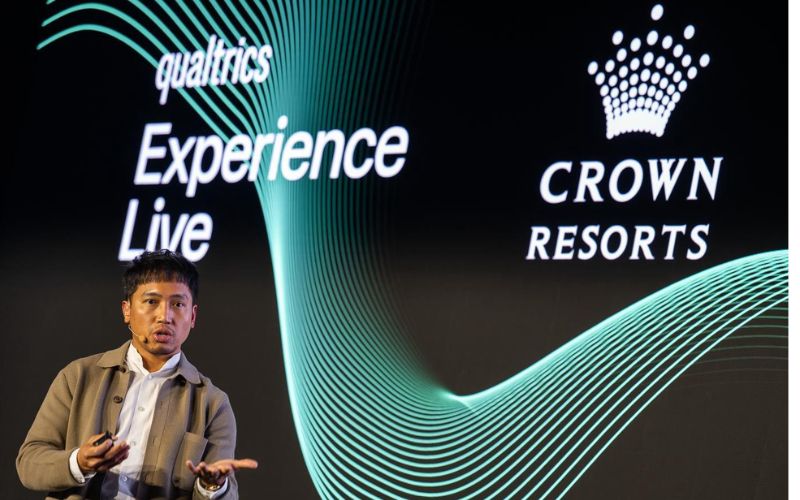
At this week’s Qualtrics Experience Live event in Sydney, the conversation focused on the impact and potential of AI in terms of Voice-of-Customer (VoC) and customer feedback analysis. Despite recent negative sentiment in the VoC market—highlighted by Medallia’s financial challenges and Qualtrics’ own recent funding hurdles—the event presented an optimistic future for the sector, centred on the transformative power of AI integration.
The event started in the morning with a series of keynotes and presentations.The first keynote by Raen Lim, Managing Director, APJ Qualtrics, talked about closing the experience gap, “For decades, organsations have been swimming in data. We’ve had mountains of operational metrics telling us what happened, but we’ve always been a step behind. We captured signals too slowly, analysed them too late, and acted only after the damage was done”.
“Today, the challenge has shifted. The gap is no longer between data and understanding—that’s been solved. The new experience gap is between understanding and outcomes”.
In a world driven by AI, according to Lim, knowing why something went wrong isn’t a competitive advantage – it’s a post-mortem. real victory belongs to organisations that act before the failure occurs.
Many companies are still treating symptoms rather than causes. They see a customer leave a 6/10 rating and offer a generic discount. But without context, that 6/10 is meaningless. Is it a loyal customer having a bad day? A harsh grader who is actually satisfied? Or a high-value account on the verge of churning?
The morning keynote also featured the ‘King of CX’, Ken Hughes. Using Taylor Swift and her rise to entertainment dominance as a case study, Hughes challenged the audience to shift from transactional thinking to relationship building, arguing that personalisation is no longer a luxury but a baseline expectation.
Drawing from his 2025 book, Taylormaking: A New Era of Modern Branding and Customer Connection, Hughes used the Taylor Swift phenomenon to illustrate the shift from transactional business to tribal connection. Taylor Swift isn’t just a musician, according to Hughes, she is the CEO of the world’s most successful customer experience brand.
A central theme of the event was the power of AI to help organisations understand their customers both at scale and within specific contexts.
Last year Qualtrics released its Experience Agents as part of its Agentic AI innovations to automate understanding at scale, moving beyond surveys to deliver proactive, personalised experiences. At this year’s event Qualtrics’ showcased some of the work its customers has undertaken and how they’ve integrated AI into their VoC and customer insights programs.
In the afternoon, attendees heard from organisations like Zip.co, Swyft, Fonterra, CBA and Crown Resorts about the application of AI to understanding customers and employees. The sessions were split into three specialised tracks:
- Customer experience
- Employee experience
- Market research
Insights at scale and speed
When it comes to understanding customers, brands are dealing with massive volumes of unstructured data. Instead of relying solely on structured surveys and feedback, they are using AI to listen to every interaction across all channels.
AI allows CX teams chat logs, social media sentiment, and contact centre transcripts to detect customer frustration or joy without the customer having to fill out a form. Rather than spending weeks manually tagging feedback topics, AI, based on automatic text analytics, can instantly categorise thousands of comments into topic models, identifying emerging issues as they happen.
Siân Howatson, Head of Customer Insights & Automation, Swyftx, comments, “We recognised the need for a clearer path to decisions, priorities, and action, so we built a system to bridge that gap called LUMA. It stands for Listen, Understand, Measure, and Act. It’s quite similar to the Qualtrics framework, but we specifically added ‘Measure” as the bridge. At Swyftx, this is the approach we use to connect customer signals to business decisions”.
“We listen everywhere because we believe no single signal tells the full story. We aim to understand what is actually happening by connecting those signals. We measure the business impact because not all friction is created equal – we view it through the lens of revenue, cost, retention, and risk. Most importantly, we act on what matters most, prioritising friction that aligns with our strategic goals and offers fast results. Ultimately, our goal is to drive decisions, not just create more dashboards”.
Sonny Sethi, Senior Director of Market Research at Zip Co, highlighted how AI is helping to democratise data at speed and scale, “Traditional research methods have undergone a total shift. We no longer operate on timelines of two to four months. Instead, I frequently launch surveys on a Friday and have the insights ready for a press release by Monday. Data from a thousand real customers can be processed and analysed in just a few hours”
“People are becoming much more closely aligned with their customers. The major shift over the past year is that we are finally utilising the vast amount of information collected over previous years—data that used to just sit there. Thanks to the advantages of LLMs and AI, we are actually putting that information to work. Personally, I’m now leveraging data spanning the last three years. The big change is that this infrastructure and access layer now sits across the entire business”.
AI agents can go beyond simple conversation to detect negative sentiment in real-time and provide immediate resolutions like discounts or human escalations to save customer relationships.
This focus on agility extends to adaptive research tools that use dynamic questioning to tailor surveys based on user input, improving response quality and completion rates. Additionally, the emergence of synthetic research panels is allowingbrands to simulate consumer personas and test marketing messages at incredible speeds, ensuring product strategies resonate with the Australian market.
